 The Archive
Fet-Mats of the Falun Mine: The Miner Who Came Back After 42 Years
Fet-Mats was Mats Israelsson, a young miner who vanished in the Falun copper mine in Sweden in 1677. On 2 December 1719, workers draining an old shaft found his body in the water, still looking as young as the day he disappeared. The only person who recognised him was the woman he had been engaged to, by then an old woman.
 The ArchiveFet-Mats of the Falun Mine: The Miner Who Came Back After 42 YearsWatch the film in the app
He had been dead for forty-two years, and he didn't look a day older. That's how the film opens, and it's a true story that has been told for almost three hundred and fifty years.
The man was Mats Israelsson. People called him Fet-Mats. His body came up out of the Falun mine in the winter of 1719, and what happened next turned him into one of the strangest legends in Scandinavia.
Fet-Mats: key facts
- Who: Mats Israelsson, known as Fet-Mats, a miner from Svärdsjö, a few Swedish miles (some tens of kilometres) from Falun.
- Disappeared: one day in March 1677, when he went down alone into a shaft and never came back up.
- Found: 2 December 1719, in the water of an old shaft called Mårdskinnsfallet.
- Recognised by: his fiancée, Margareta Olsdotter, who had grown old in the forty-two years he was gone.
- Why the body survived: the mine water was full of vitriol, a salt of copper and iron.
- Where: the Falun mine (Falu gruva) in Dalarna, Sweden, now a World Heritage Site.
What was the Falun mine?
The Falun mine is very old. People had been digging copper out of this mountain since the Viking Age. Copper is a reddish-brown metal, and it was used for coins, kettles and roofs.
A large share of Europe's copper came from Falun. The mine made Sweden rich and powerful. But the work underground was hard. It was dark, wet and dangerous. The only light came from torches, and the water in the tunnels was green with copper.
Today the whole site is a World Heritage Site, which means it is meant to be protected for everyone.
How did Fet-Mats disappear in 1677?
Mats Israelsson worked in the mine as a miner's hand. He was engaged to Margareta Olsdotter. They had promised to marry.
One day in March 1677, Mats went down into the mine. He walked alone into a shaft, a passage dropping straight down into the rock, like a deep well. He never came up again.
Nobody knows for sure what happened. Maybe he fell. Maybe the rock caved in. His body was not found. The years went by, Margareta grew older, and life in Falun carried on.
The Great Pit of 1687
Ten years later, on Midsummer Day 1687, the mountain collapsed. Three big pits turned into one giant hole, ninety-five metres deep. It's known as Stora stöten, the Great Pit. Remarkably, nobody died. It was a holiday, and no one was working underground.
The mine filled with rubble and water. Old passages were shut off and forgotten. One of them still held Mats.
How was the body found in 1719?
On 2 December 1719, miners were draining the water from an old shaft called Mårdskinnsfallet. No one had worked there in a long time. In the water they found a dead man.
He lay still, as if he were asleep. His clothes were whole. His face was whole. He looked young, as if he had only just died. But nobody in Falun was missing, and none of the miners knew who he was.
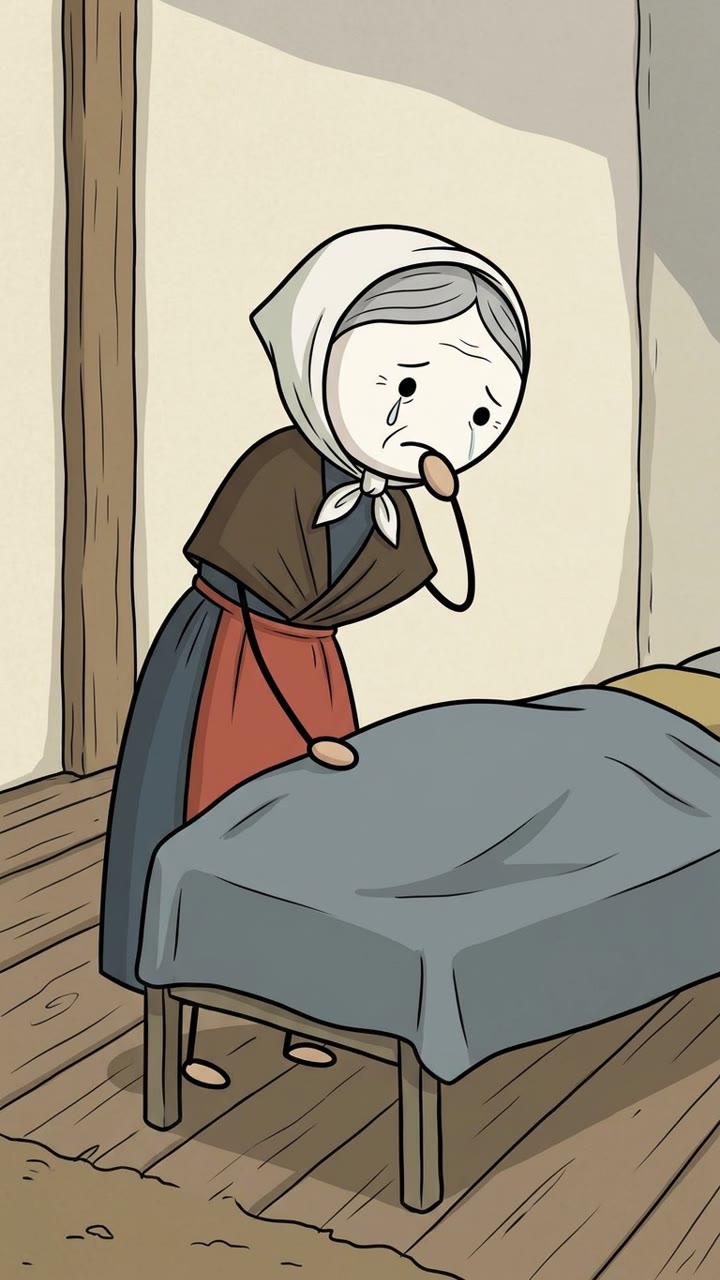
They carried him up into the daylight and a crowd gathered. Then an old woman stepped forward, looked at his face, and began to cry. It was Mats, she said. Her fiancé. He had disappeared in the mine forty-two years earlier. She had grown old. He was still young.
Why didn't the body decay?
The answer was in the water. The mine water was full of vitriol, a salt of copper and iron. Today we would call part of it copper sulphate. It kills the tiny living things that normally break a body down.
The film compares it to salting fish for the winter. The salt keeps the fish whole for years. The mine water did the same to Mats.
Once he was brought up into the air, the body dried out and went hard as wood. People started calling him "the petrified miner", and many still believe he turned to stone. He didn't. A young naturalist named Carl Linnaeus, who visited Falun in 1734, is said to have seen that the body was not stone at all, only soaked through with vitriol.
Why is Fet-Mats famous outside Sweden?
His story travelled. German writers read about the man from Falun. In 1811 Johann Peter Hebel wrote the short story Unverhofftes Wiedersehen ("Unexpected Reunion"), in which the bride waits fifty years instead of forty-two. A German philosopher later called it the most beautiful story in the world. In 1819 E. T. A. Hoffmann wrote about the mines of Falun, and Mats became a tale told all over Europe.
What happened to his body after 1719 is a story in itself, and it took more than two hundred years before Mats Israelsson finally got a proper grave. The film tells that part, and how Margareta's long wait ended.
Watch the full film
The full film follows Mats from the day he walked into the shaft in 1677 to the crowd at the pithead in 1719, and then on through the strange afterlife of his body, from Linnaeus to the church floor in Falun. It ends with the one goodbye Margareta finally got to say. You can watch the whole film in The Archive app, along with more stories from The Archive.