 The Archive
The Chernobyl disaster: The shoes at Forsmark that gave it all away
Chernobyl was discovered by the outside world when a radiation alarm went off at the Forsmark nuclear power plant in Sweden on Monday, 28 April 1986, because of radioactive particles on a chemist's shoes. The reactor in Soviet Ukraine had exploded two days earlier, and Moscow had told no one. Swedish questions forced the Soviet Union to admit the accident that same evening.
 The ArchiveThe Chernobyl disaster: The shoes at Forsmark that gave it all awayWatch the film in the app
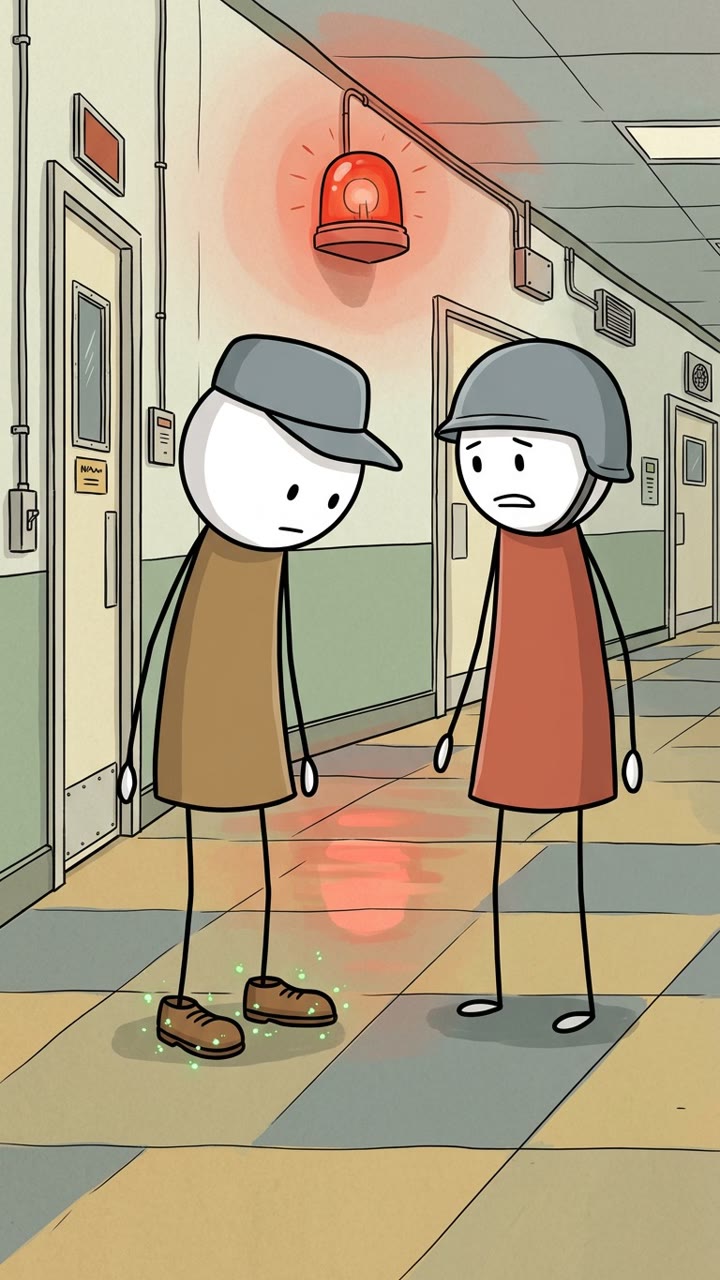
One of the worst nuclear accidents in history was given away by a pair of shoes. They belonged to a chemist at a Swedish power plant, and they had never been anywhere near radiation.
The Soviet Union had kept quiet for more than two days. Then, on a Monday morning north of Stockholm, a radiation detector started beeping, and the secret began to come out.
Key facts: how the world found out about Chernobyl
- The accident: Reactor 4 at the Chernobyl nuclear power plant in Ukraine, then part of the Soviet Union, exploded at 1:23 a.m. on Saturday, 26 April 1986.
- The silence: The Soviet Union said nothing to the rest of the world.
- The alarm: Shortly after 7 a.m. on Monday, 28 April 1986, chemist Clifford Robinson set off a radiation detector at Forsmark nuclear power plant in northern Uppland, Sweden.
- The evacuation: At 11 a.m. the alarm sounded over the loudspeakers, and around 800 employees had to leave Forsmark.
- The admission: Shortly after 7 p.m. that evening, Moscow confirmed an accident at Chernobyl and that reactor 4 had been destroyed.
- The fallout in Sweden: The Gävle area was hit hardest, and 78 percent of reindeer meat was thrown away in 1986.
What happened at Forsmark on 28 April 1986?
Forsmark is a nuclear power plant on the coast of northern Uppland, in Sweden. Just after seven on Monday morning, chemist Clifford Robinson walked out of the changing room. On his way he passed through a radiation monitor, a frame that staff walk through to check for contamination.
It went off. There were radioactive substances on his shoes. Radiation can't be seen, so the only warning was the machine. The strange part was that Robinson's shoes had never been inside the areas of the plant where there is radiation.
Soon the monitor was going off for more and more people arriving for work. Inside the plant, everything looked normal. Outside, on the ground, there was radiation.
The first assumption was a leak from one of Forsmark's own reactors. At 11 a.m. the alarm rang out over the loudspeakers, and about 800 employees were ordered to leave the plant. The managers gathered in the control center, among them Karl Erik Sandstedt, and started hunting for the source. Could there be damaged fuel in reactor 3?
But Forsmark was not leaking.
What happened at Chernobyl, and when?
The answer starts two days earlier and more than 1,000 km away. On the night leading into Saturday, 26 April 1986, staff at the Chernobyl nuclear power plant in Ukraine were running a test on reactor 4.
A nuclear power plant makes electricity from heat. In the reactor, uranium is split, and that creates a great deal of heat. The heat turns water into steam, and the steam drives a turbine that generates power. That night, the operators wanted to test how the reactor would be cooled if the electricity were cut.
Something went wrong. At 1:23 a.m. the reactor exploded. The roof was torn open, fire broke out, and a column of radioactive smoke rose into the sky. Firefighters battled the flames. Two men died that same night.
The Soviet Union told the outside world nothing.
The evacuation of Pripyat
The next day, the town of Pripyat, right next to the plant, was emptied. Around 50,000 people had to leave their homes. They were only allowed to take papers, books and clothes that weren't contaminated. The town still stands empty today.
How did the radioactive cloud reach Sweden?
The wind was blowing to the northwest, toward Sweden. At around six on Sunday morning, 27 April, the cloud reached the Swedish islands of Gotland and Öland. It was a beautiful spring day and people were out in the sun. No one knew a radioactive cloud was drifting in over the country.
Many people believe Forsmark was the first place to measure the radiation. It wasn't. On Sunday, a needle was already rising at the southern tip of Öland, and radiation was also going up in Eksjö, Erken and Solna. But most of those instruments only drew their readings on a paper disc that was changed once a week. Nobody noticed.
That is why the alarm came on Monday, at Forsmark, from a pair of shoes.
How did Sweden prove the radiation came from the Soviet Union?
That Monday turned into a race between Forsmark's chemists, the Swedish defense research agency FOA in Stockholm and the weather service SMHI. One clue in an air filter showed the radiation came from a nuclear reactor and not a bomb, and the weather pointed east, across the Baltic Sea.
How they cracked it, and how Sweden's government pushed Moscow into admitting the truth, is the heart of the film. The full story is in the film in The Archive app.
For more on the science behind nuclear reactors, read our piece Is heavy water toxic?
What were the effects of Chernobyl in Sweden?
Where it rained, the radioactive particles came down with the rain. The Gävle area was hit hardest. The fallout ended up in grass, mushrooms and lichen. Cows had to wait longer before being let out to graze.
Reindeer eat lichen, and their meat became radioactive. In 1986, 78 percent of reindeer meat was discarded, a disaster for the reindeer herders. The following year, reindeer meat, game, freshwater fish, berries and mushrooms were given a higher limit for how much radiation food was allowed to contain.
At Chernobyl itself, 28 of the people who fought the accident died of radiation sickness within a few months. How many died later, nobody knows for certain, and estimates vary widely. A zone was sealed off around the plant, first 10 km, then 30 km. Since 2016 the reactor has been covered by a giant steel arch.
Watch the full film
The full film follows that Monday hour by hour, from the alarm at the changing room door to the evening Moscow had to speak. It shows how a few Swedish scientists traced invisible particles back across the Baltic, and the message Forsmark sent out the day after. Watch the whole story in The Archive app.