 The Archive
Laksevåg bombing 1944: the bombs meant for U-boats that hit a school
The Laksevåg bombing of 1944 was a British air raid on Bergen, Norway, on the morning of 4 October 1944. More than 150 aircraft were sent to hit the German U-boat bunker Bruno, but most of their bombs fell on homes in Laksevåg. One hit the basement of Holen School, where children were sheltering. 193 civilians died, 61 of them pupils from the school.
 The ArchiveThe Bombing of Laksevåg: The School Under the BombsWatch the film in the app
The bombs were meant for German submarines. They hit a primary school instead.
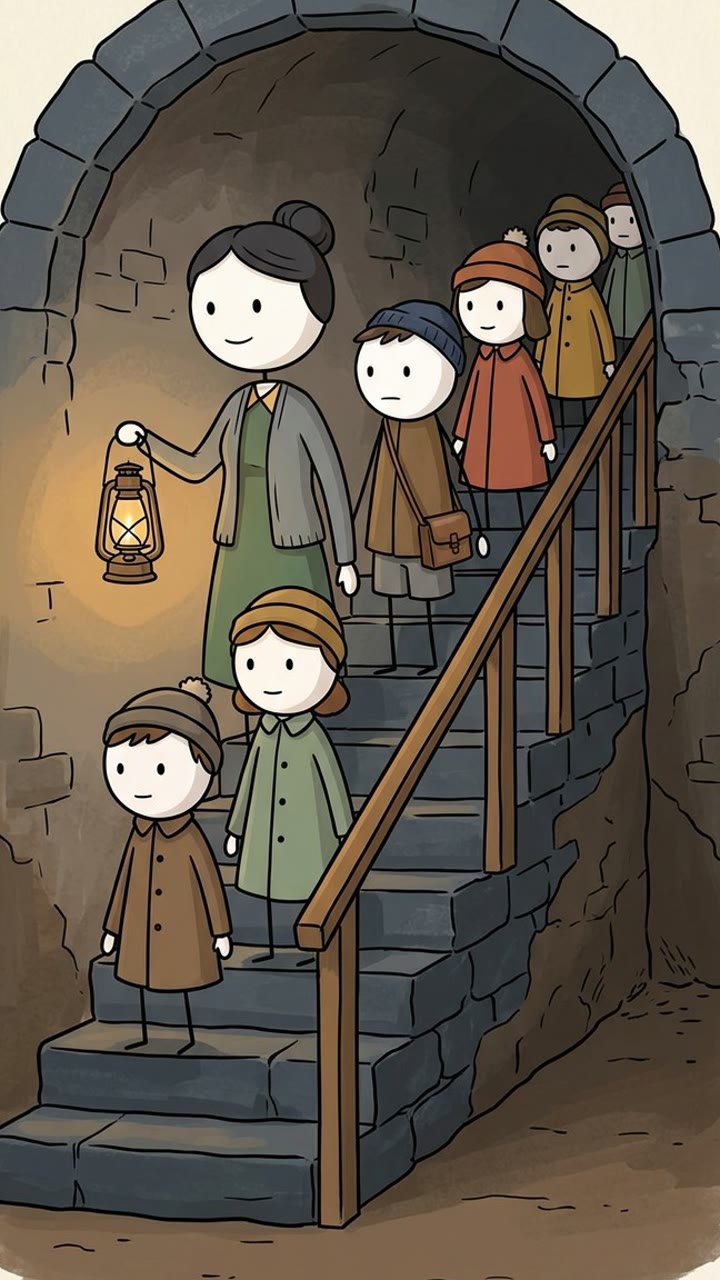
It was a Wednesday morning in Bergen. At Holen School in Laksevåg the teachers had practised the air raid drill many times. The children went down to the basement, which was supposed to be the safest place in the building. That is where the bomb landed.
Key facts about the Laksevåg bombing
- Date: Wednesday 4 October 1944. The air raid siren went off at 9:05 am.
- Place: Laksevåg, a district of Bergen on Norway's west coast.
- Target: Bruno, the German U-boat bunker on the Laksevåg waterfront.
- Attackers: More than 150 British aircraft, which dropped over 1,400 bombs in a few minutes.
- Dead: 193 civilians, among them 61 pupils from Holen School, two teachers and the school caretaker.
- Damage: About 180 injured, about 600 people left homeless and 60 houses completely destroyed.
Why did the British bomb Bergen?
Britain and Norway were allies, on the same side of the war. So why would British bombers attack a Norwegian town?
The answer starts out at sea. During the war Britain depended on food, fuel and weapons shipped across the Atlantic from America. If the convoys did not get through, Britain could not keep fighting.
German U-boats hunted those ships. A U-boat is a warship that can travel underwater, creep up on a ship and fire torpedoes at it. Germany had U-boat bases along the coast of occupied Norway, and Bergen was one of them. From there the submarines had a short run out into the North Sea and the Atlantic.
To protect the boats, the Germans built a huge bunker at Laksevåg called Bruno. Picture a garage with a concrete roof so thick that bombs bounce off it. And it was not out in the wilds. It sat right among the shipyards, factories and small wooden houses where people lived. Holen School was only a few hundred metres away.
Was the Laksevåg bombing a mistake?
Many people believe the disaster came down to one pilot's error. The sources tell a different story.
In London there was disagreement about the raid. The navy wanted the U-boats hit almost at any price. The leadership of the bomber force was doubtful. They knew the bombs would not go through the bunker roof, and they knew many bombs would land on the town around it.
So the danger to civilians was known in advance. It was a known risk, not an accident. The raid went ahead anyway.
What happened at Holen School on 4 October 1944?
That morning the bomber crews flew in across the North Sea. The force was made up of:
| Aircraft | Number | Role |
|---|---|---|
| Handley Page Halifax | 93 | Heavy bomber |
| Avro Lancaster | 47 | Heavy bomber |
| de Havilland Mosquito | 12 | Fast escort aircraft |
Down in Laksevåg it was an ordinary school day. Holen School had around 350 pupils. One of them, whose story the film follows, was a ten-year-old boy with a desk, a packed lunch and homework.
Part of the school basement had been turned into an air raid shelter. It was also the base of the civil air defence, volunteers whose job was to help the wounded after an attack.
At 9:05 the siren wailed across the town. Pupils and teachers went down to the basement to wait it out. Out in the streets many people were slower to move. They had heard the siren plenty of times before, and it was often a false alarm.
Then the bombing began. Only a few bombs hit the bunker. Most fell on the houses between Nygård and Damsgård. Three hit Holen School, and one of them, a 450 kg bomb, went straight down into the basement. Two boys' classes were sitting there with their teachers. They were boys of ten and eleven.
How many people died in the Laksevåg bombing?
In total, 193 civilians were killed that morning.
- Holen School: 61 children, two teachers, the caretaker and 16 people from the civil air defence.
- Kleivdal tannery: 36 workers died in the factory's shelter.
- A bucket factory nearby: 11 dead.
The figure for the children varies. Some sources say 60, others 63. The memorial at the school lists 61.
What happened next?
The question everyone asks is what became of the bunker, and what the raid actually achieved. The film answers that. It also covers a second raid on Bergen three weeks later, and the long fight the surviving children had to get their wartime injuries recognised, which lasted more than sixty years. All of that is in the full film in the app.
If you're interested in other British operations in occupied Norway, read about the Operation Claymore commando raid on Lofoten.
Watch the full film
The full film follows the morning of 4 October 1944 minute by minute, then tells what happened to Bruno, to Laksevåg and to the children who survived. It ends at the memorials that stand in Bergen today. Watch the whole of The Bombing of Laksevåg: The School Under the Bombs in The Archive app for iPhone.